22.05.2025
Across the UK sport is flourishing. In football alone, £5 billion is flowing into stadium and regeneration projects. Sport is attracting investment where some sectors may be struggling and in doing so it is quietly reshaping our cities.

For decades, the dominant model was the standalone stadium: iconic, inward facing towards the sport function, alive on matchday and dormant the rest of the week. We know that this model is giving way to something more ambitious: venues that are the starting point for integrated civic districts and neighbourhoods, ‘facing out’ towards a life that extends well beyond the final whistle.
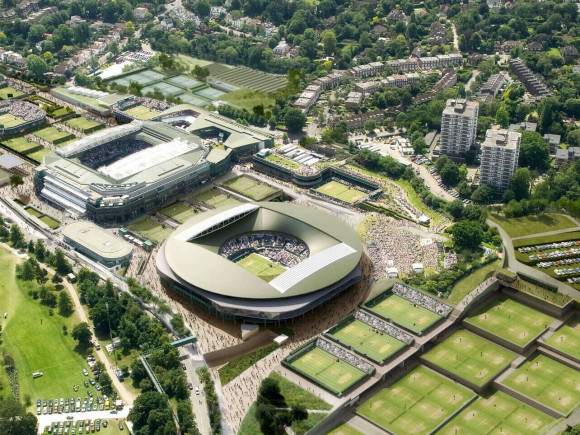
This choice of ‘facing both ways’ brings with it particular demands: to be civic and commercial, inherently permeable and safe, and sport-focused with community purpose. Yorkshire Cricket Club (YCC) has set its commitments to this through its 10-year strategy, the AELTC is embarking on Wimbledon Park Project which fulfils an ambition for the community by enabling public access to a site for the first time in 100 years, and in Birmingham, Grimshaw is working with Aston Villa for the redevelopment and expansion of Villa Park which will include a thriving community hub.
These are all ‘places’ that are looking at impact through a social and an economic lens. And what is evident is that the pre-existing loyalty that sport carries, it’s local identity, generational staying power and authenticity is something that no masterplan can manufacture from scratch. SW19 is tennis, Hampden Park is the home of Scottish Football. Sport brings a certainty of the ‘place’ and draws people, which matters to investors, developers, local authorities and to local communities - with durability where other investment might fail.
So sport is something special. From grassroots teams to international audiences, most of us have a place for a club, a ground, or a game. But does sport make a place? And can a venue, however well-designed, become a genuine part of everyday urban life?
The deepest challenge is year-round relevance. Headingley, home to Yorkshire County Cricket Club, sits unused for 87% of the year - a figure the YCC's 10-year strategy addresses. A venue closed to its community for most of the year cannot function as a true civic anchor, however much it matters on matchday. Designing for permeability means embedding facilities that work with the rhythms of daily life, not just the seasonal match cycle.
But year-round relevance alone isn't enough. The critical connection is to the wider city – transport networks, housing and cultural hubs. Sporting infrastructure that serves elite competition without linking to its surroundings misses the point. The opportunity is to design venues not as objects in the city, but as part of it: open, legible and genuinely useful to the people who live nearby, not just those who arrive on event day.
And when you don’t have a venue - a single destination - such as the forthcoming 2027 Tour de France Grand Départ in the UK, the sport is about bringing people together; woven into the fabric of the towns and cities it passes through. This is sports investment measured not just in economic output but in shared identity.
What unites these examples is a shift in how we measure the value of sports investment. Yes, sports venues create jobs, support local economy and contributes to the GDP, but the eyes are on whether it will make a neighbourhood healthier, more connected and more resilient. Whether it earns its place in the city not just on event day, but every day and whether it is worthy of the communities that have always been their foundation. Placing sports investment in our cities as a national conversation is the next step. Sport has the loyalty, and the task is, with investment, to ensure we build better cities, not just stadiums.
*Thank you to UKREiiF 2026 and my fellow panellists on ‘Making a play’ panel: Heather Topel, Estate Director, All England Lawn Tennis Club; Jon Dutton OBE, Group Chief Executive, British Cycling; Max Chambers, Corporate Affairs Director, The Premier League; Rucelle Soutar, Chief Operating Officer, Scottish Football Association; and Sanjay Patel MBE, Group Chief Executive, Yorkshire Cricket Club. This article cites projects and viewpoints shared as part of the panel session.


←