16.09.2025
With over four decades working with Nick Grimshaw, Andrew Whalley, Chairman of Grimshaw reflects on Nick’s career - his ideas, creativity and passion. From the early founding days of the practice in 1980, through the key projects of International Terminal Waterloo and Eden Project in Cornwall, Andrew describes Nick’s spirit of invention and the commitment to architecture and its purpose.

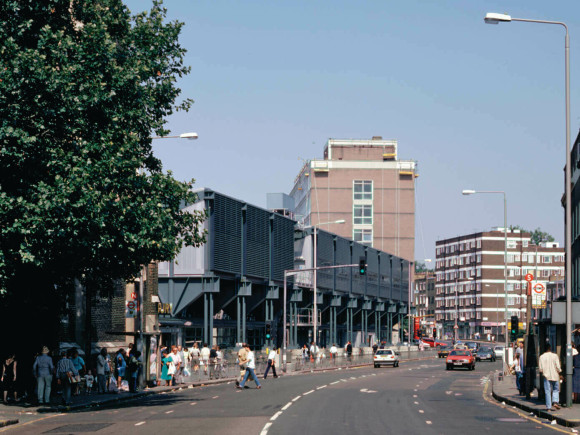
In the mid-1980s, when I joined Nick Grimshaw’s practice, the office was just 12 architects. It was a small but ambitious team navigating the harsh realities of an economic downturn. The practice was sustained by a portfolio of sports facilities, industrial commissions, and one particularly important project: a Sainsbury’s Superstore in Camden.
The Camden store was emblematic of the practice’s architectural language. It was a highly articulated steel structure with a long-span arched roof suspended from cantilevering steel gerberettes. It spoke of clarity, invention, and the expressive potential of industrial technology — exactly the kind of architecture that had captivated me during my student days.
At the time, however, London’s building regulations made it almost impossible to expose structural steel. What made the Camden project possible was Firec — a new fire-protection coating developed by ICI for oil rigs and nuclear facilities. This single technological innovation suddenly enabled architects to reimagine the role of structure in architecture.
I still remember studying the model and its beautiful skeletal form while waiting in the reception area, hoping for an interview. Just beyond reception sat Nick in his glass box, supported by a Meccano-like aluminum structure. He was wearing round translucent-rim glasses, giving him the air of the boffin inventor. It turned out there was no vacancy, but I was asked to leave my portfolio. As luck would have it, Nick later reviewed it, decided to find a place for me, and invited me back.
That invitation began a working relationship — and friendship — that has lasted four decades.
From the outset, what struck me most about Nick was his instinct for balancing economy with ingenuity. His designs were not driven by extravagance but by invention: using industrial methods and everyday materials in surprising, efficient, and expressive ways.
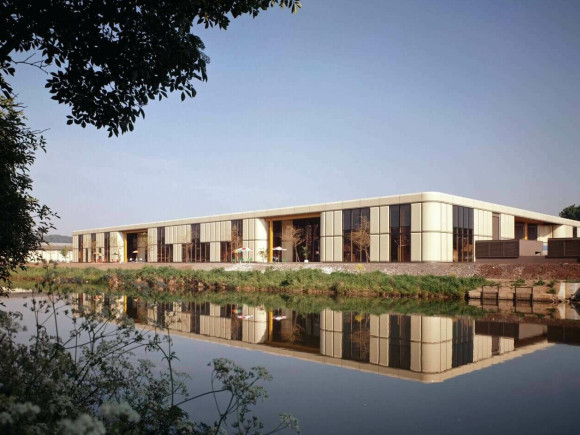
At Herman Miller’s factory in Chippenham, pressed aluminium cladding became both pragmatic and elegant. At the earlier Herman Miller facility in Bath, fibreglass cladding created a flexible skin capable of adapting as the building evolved. These were not simply façades but living envelopes — architecture that anticipated change.

Nick had an extraordinary gift for working directly with fabricators and manufacturers, persuading them to adapt their techniques for architectural purposes. He was endlessly curious about how things were made. Ultimately, he was driven by the craft of building. That curiosity and imagination were coupled with tenacity and the ability to convince others that a daring idea was not only possible but also sensible.
I witnessed this first-hand when I was asked to accompany Nick to a recently completed building, Ladkarn, to represent the owners. It was a large light steel shed for heavy haulage and construction vehicles plus offices, with a nautically inspired bright red external structure. It was, however, in the middle of what would become the Canary Wharf Development, and it was in the way. The then developer, G Ware Travelstead, arrived in his stretch limo to persuade them to move. Nick negotiated a remarkable outcome: the building was dismantled and relocated, the owners were compensated with a new site, and a generous financial settlement was secured. It was a lesson in pragmatism, determination, and the art of persuasion.
The second half of the 1980s brought a wave of projects, all on compressed timelines. It was the height of Thatcherism; postmodernism dominated architectural culture; London’s skyline was filling with speculative towers. Against this backdrop, Nick pursued a different course — one rooted in logic, clarity, and industrial precision.
His principle was simple: amplify the structure, simplify the cladding, and let economy generate expression.
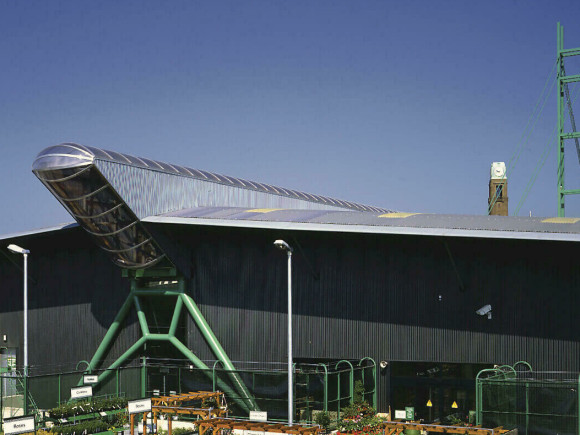
The Homebase store in Brentford, completed in just 18 months, was a case in point. A vast column-free retail hall was supported by wing-like external trusses. The cladding was nothing more than standard aluminium sheets, given a distinctive texture by passing them through a crimping machine. Minimal means, maximum impact.
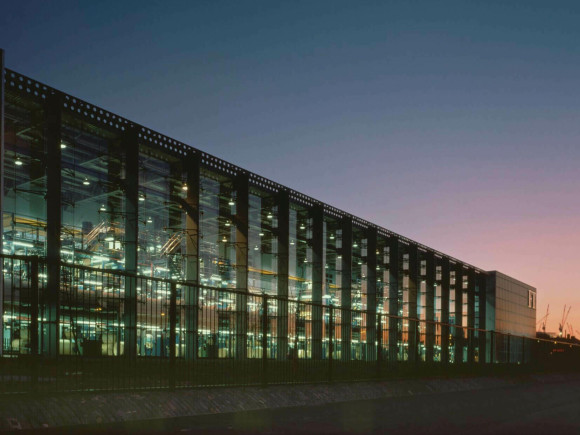
The Financial Times printworks in London Docklands, pushed this approach further. Designed and completed in nine months, it displayed its presses behind a 96-metre-long glass wall, supported by steel fins reminiscent of yacht masts. At night, commuters watched the pink pages of the next day’s FT rolling off the presses. Jean Muir described it as ‘an inlaid jewel box.’ Industrial function had become urban theatre.
Inside the office, hierarchy was almost non-existent. The practice was a meritocracy: ideas were the currency, and anyone could contribute. This atmosphere was shaped directly by Nick’s personality — genial, open, and collaborative.
The roots of this culture lay in his own background. Born in Hove in 1939, he was the son of an aircraft engineer and an artist. His father died when Nick was very young, and he was raised by his mother and grandmother, both artists. Their affection and creativity shaped his outlook and personality.
At the Architecture Association in the 1960s, he was taught by the Archigram generation. His thesis — a modular, metabolic reimagining of Covent Garden — was presented as a stop-motion animation, decades ahead of its time. It foreshadowed his fascination with adaptability and biomimicry.
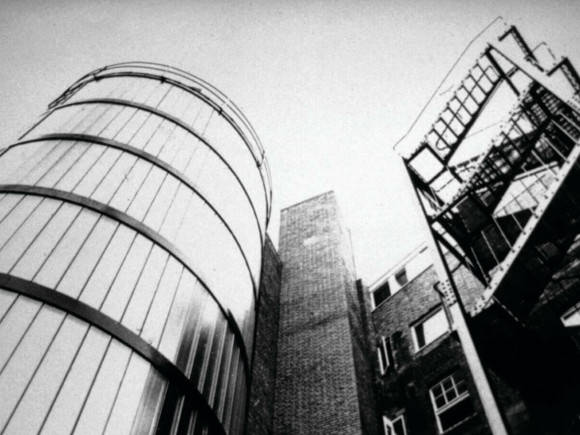
His first commission, the Service Tower in Paddington, distilled this ethos: prefabricated bathroom pods spiralled around a service core, bolted onto existing housing. Part sculpture, part machine, it was an act of architectural ingenuity and a manifesto for adaptive reuse long before the term was coined.

In the 1970s, Nick formed a partnership with Terry Farrell. But by 1980, their differing approaches — Farrell leaning towards postmodernism, Nick resolutely modernist — led to a split.
By the late 1980s, critics were grouping Grimshaw with Foster, Rogers, and Hopkins as the ’High-Tech Four.’ Yet Nick’s work was closer in spirit to Jean Prouvé and the great 19th-century engineers such as Paxton and Brunel: pragmatic, inventive, and humane.
The pivotal moment came in 1988 with Product + Process, a RIBA exhibition that presented not just drawings and models but full-scale building components from the practice. It embodied Nick’s conviction that architecture was as much about process as product. The exhibition caught attention just as British Rail was seeking an architect for the Channel Tunnel terminal at Waterloo.
Winning Waterloo was audacious for a practice of our size. We had no CAD facilities — just typewriters and a fax machine. Mainframes were out of reach financially. On the advice of Archigram’s Ron Herron, Nick took a different gamble: Apple desktops. At the time, it seemed eccentric. In practice, it gave us a crucial advantage.

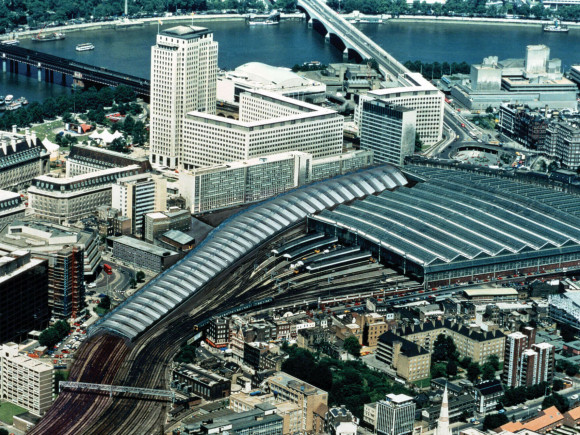
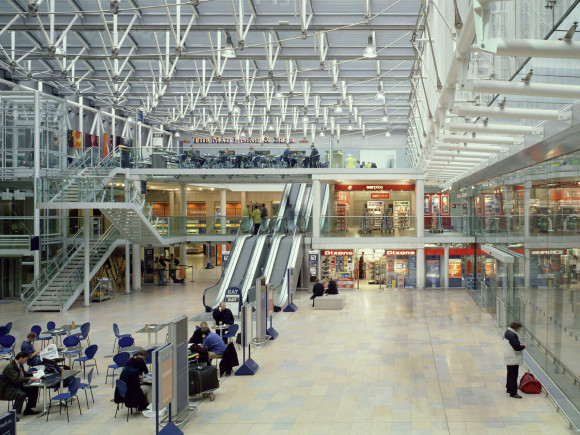
The station was built in just 36 months. Its vast curving roof of glass and steel captured the drama of the great railway halls while addressing the complexity of an international terminal.
Waterloo won the RIBA Building of the Year and the Mies van der Rohe Prize. More importantly, it demonstrated that a modestly sized, inventive practice could deliver one of the most significant pieces of infrastructure of the era. Norman Foster put it succinctly: “In Nicks's outstanding work, there is this integration of engineering; the structure becomes the architecture, and the architecture is the structure, so there is a purity in that, and particularly when you move around the exterior of Waterloo Station, you can see that on this kind of noble curve.”
Waterloo was always Nick’s favourite building.
Amid the turbulence of Waterloo, we were also selected to design the British Pavilion for Expo ’92 in Seville. Nick’s first sketch captured the essence of the final design: photovoltaic panels, cascading water walls, lightweight fabric enclosures. Visitors stepped from the searing Andalusian heat into a naturally cooled environment.
It was one of the first projects to integrate renewable energy and climate-responsive design in such a public way. For Nick, it was the beginning of what would become a 40-year exploration of sustainability.
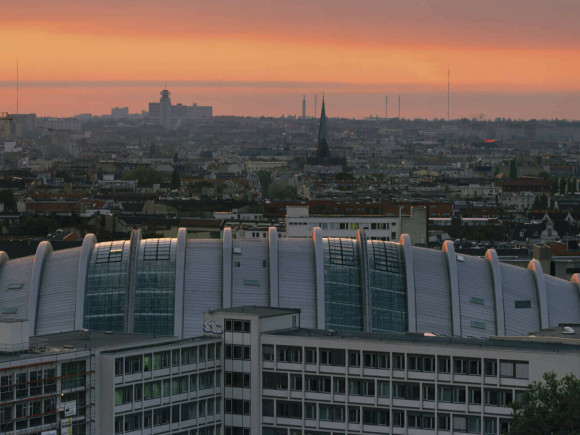
The late 1980s brought dramatic change with the fall of the Berlin Wall and Germany’s reunification, returning its capital to a fragmented Berlin in need of rebuilding. Grimshaw was invited to compete for the design of the Ludwig Erhard Haus, the new German Chamber of Commerce. The proposal maximised volume within strict height and daylight constraints, something none of the other schemes achieved. Its curving form posed construction challenges, resolved by a steel arch rib cage. This seemingly gymnastic structure allowed all floors to hang from the trusses, creating generous, column-free public spaces at ground level — a bold gesture to the city. The project marked a new phase in Grimshaw’s work, with greater emphasis on public projects in complex urban settings.
We also worked more with existing and listed buildings, such as the masterplan and redevelopment of Brunel’s Paddington; the opportunity to work on an important Brunel building was a delight for Nick. As we completed that project, we frequently travelled from Paddington to Cornwall for another key building: the Eden Project.
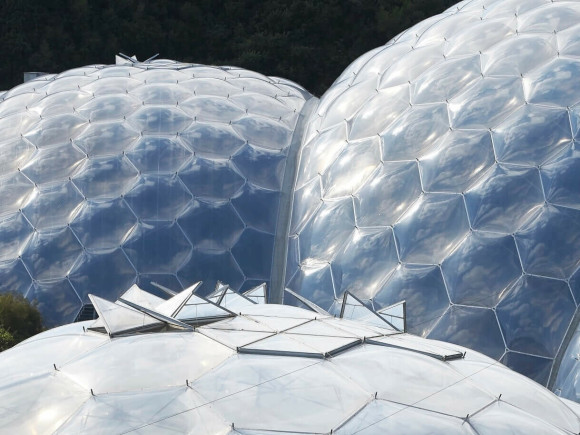
Lottery funding created opportunities for projects such as the National Space Centre in Leicester, Millennium Point in Birmingham, and the Thermae Bath Spa in Bath. Each demanded a different balance between boldness and sensitivity: from the ETFE domes housing rockets in Leicester to the stone cube of Bath, suspended over a pool in a UNESCO World Heritage city. But the Eden Project in Cornwall was the most transformative. Initially conceived as vast trusses, the design evolved into interlocking ETFE biomes, like soap bubbles, adapting to the quarry’s shifting contours. Completed in 2001, Eden has become an international landmark — not just for its architecture, but for its significant impact on Cornwall’s economy and culture. Since opening, it has attracted millions of visitors and catalysed over £2 billion in regional investment.

Internationally, the practice expanded. A New York office opened in 2001, followed by Melbourne. The Experimental Media and Performing Arts Center (EMPAC) in Troy, New York, fused perfect acoustics with experimental media, while IGUS in Cologne became a ‘cathedral to manufacturing,’ flexible and light-filled.
In 2002 Nick was knighted. In 2004 he was elected President of the Royal Academy, guiding the institution through difficult financial and governance challenges.
At Grimshaw, he ensured succession by restructuring the practice as an LLP in 2007, opening ownership to new generations. This was not just a legal shift but a cultural one: a recognition that Grimshaw was no longer a single architect’s studio but an international network.
Recognition followed. In 2019, he was awarded the RIBA Gold Medal. Norman Foster described him as “driven, focused, consistent.” Jon Snow said: “He does indeed want to change the world for humanity; he wants to improve people’s lives through the built environment.”

In 2022, he established the Grimshaw Foundation, dedicated to supporting under-represented young people entering creative careers. It was the logical extension of his belief that architecture must serve society — and that the profession must reflect the communities it serves.
From the Service Tower in 1967 to the Elizabeth Line in 2022, Nick Grimshaw’s work has consistently fused pragmatism with imagination, economy with elegance, invention with joy. His buildings are never about surface or fashion: they are about structure, craft, and purpose.
This inventive spirit is a DNA that runs through the practice and is Nick’s enduring legacy : beauty achieved through ingenuity.


←